
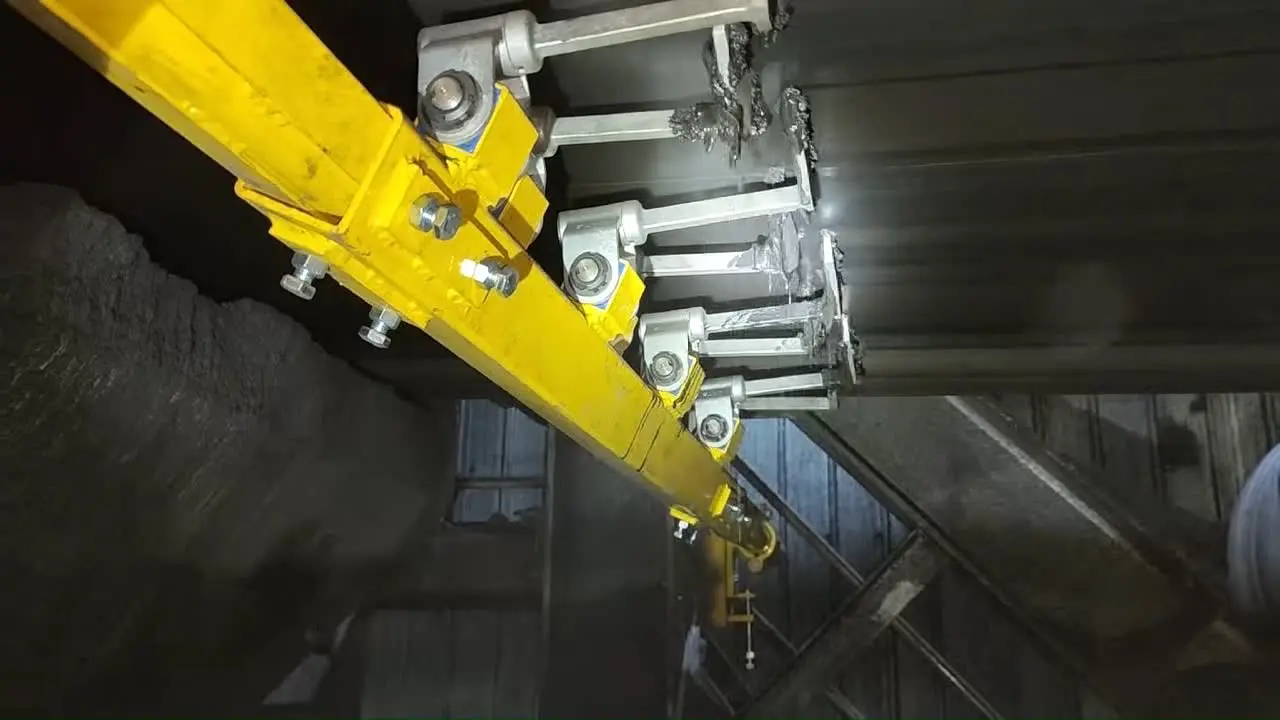
Chapter 1: The Core Role and Application Context of Belt Cleaning Devices in Industrial Bulk Material Handling
In belt conveyor systems used in mining, metallurgy, power generation, port terminals, and cement plants, the efficiency of material transport is often accompanied by operational and maintenance challenges caused by material adhesion. When conveying bulk materials with high moisture content and strong adhesion, a portion of fine particles remains firmly attached to the working surface of the conveyor belt after discharge. If not removed promptly, these residues travel with the return strand and enter the space between the idlers and pulleys, causing belt misalignment, accelerated idler wear, local material buildup, and even equipment failure.
To effectively remove adhering material from the conveyor belt, reduce unplanned downtime, and extend the service life of core conveyor components, high-performance self-adjusting (carbide) belt cleaners have been widely adopted. Through well-engineered structural design and wear-resistant carbide materials, these devices deliver stable and efficient cleaning performance while significantly reducing manual cleaning costs.
Chapter 2: Core Structural Features and Technical Advantages of Self-adjusting Carbide Belt Cleaners
2.1 High-performance Carbide Scraper Blades
The core scraper blades are manufactured from high-quality carbide materials, offering outstanding wear resistance and corrosion resistance. During prolonged, high-intensity scraping operations, the carbide blades not only remove stubborn adhering material thoroughly but also maintain a sharp cutting edge without damaging the conveyor belt surface.
2.2 Split Mounting Pole Design and Quick-replacement Structure
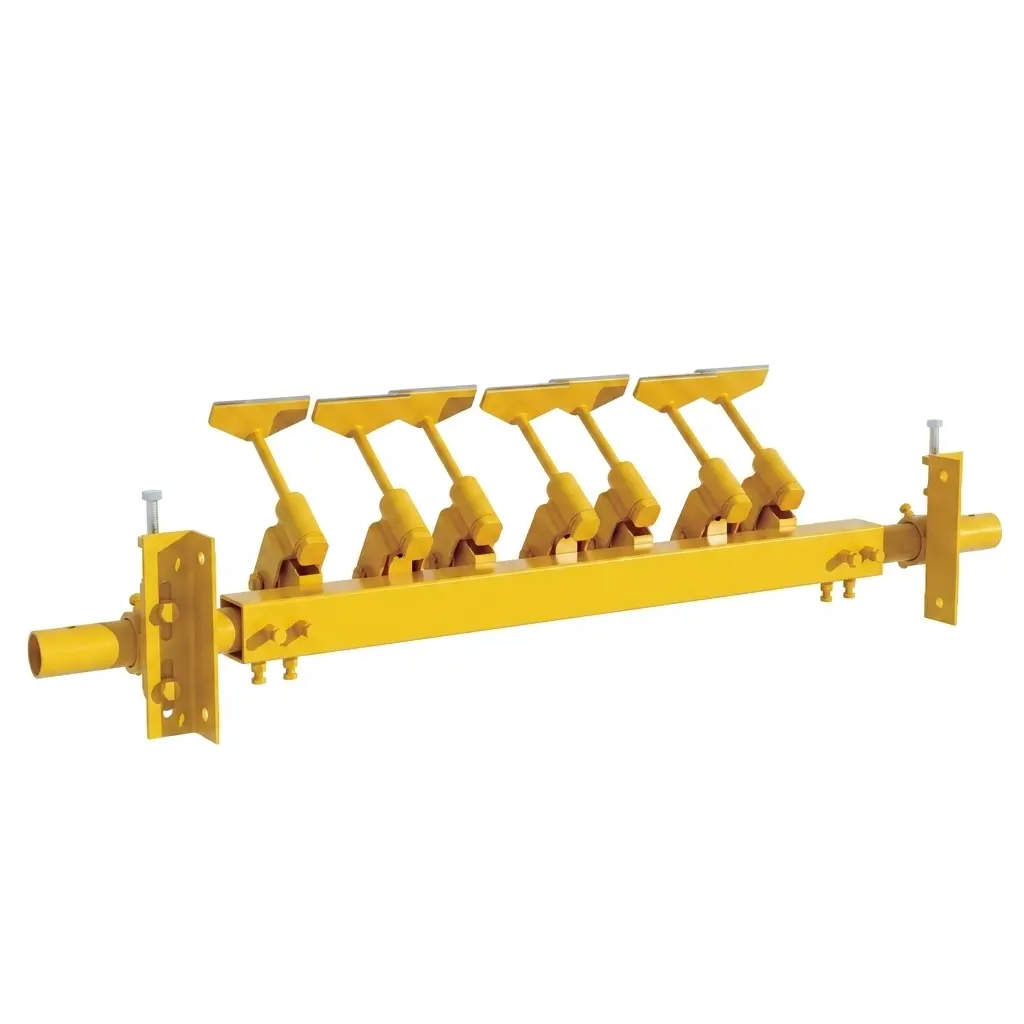
- Split mounting pole: The equipment adopts a split design combining a central mounting pole with extension poles on both sides, allowing the overall pole length to be adjusted flexibly according to different conveyor belt widths and improving installation adaptability.
- Quick-replacement design: The blade units can be easily removed and installed. Simply remove the fixing nut to replace the blade unit quickly, significantly shortening on-site maintenance and inspection time.
Chapter 3: Installation Specifications, Commissioning Steps, and Pre-operation Preparation
3.1 Main On-site Installation Steps
- Component assembly: Insert the extension poles into the square holes on both sides of the central mounting pole, adjust them to the appropriate length according to site specifications, and tighten the corresponding fastening bolts and nuts. Then install the blade units one by one onto the central mounting pole with bolts.
- Bracket positioning: Install the adjustment brackets and adjustment mechanisms. Note that during initial installation, the fasteners of the adjustment brackets and mechanisms do not need to be fully tightened, so as to leave room for subsequent fine adjustment.
- Position calibration: Adjust the relative position of the scraper blades and the conveyor belt to ensure centered alignment, and adjust the working angle appropriately according to actual pressure requirements.
3.2 Pre-operation Inspection and Trial Run
- Fastener recheck: Before operation, all fasteners must be rechecked to ensure they are firmly tightened, and tools and installation materials on and around the conveyor must be thoroughly cleaned up.
- No-load trial run: Start the conveyor and run it continuously for at least 15 minutes, closely observing the cleaning performance and operating condition of the belt cleaner. If insufficient cleaning performance or abnormal vibration is observed, stop the machine and make the corresponding adjustments.
Chapter 4: Routine Maintenance, Safety Precautions, and Troubleshooting of Common Faults
4.1 Safety Precautions and Operational Red Lines
- Strictly prohibited in non-explosion-proof environments: This belt cleaner is generally a non-explosion-proof product and must not be used directly in hazardous environments containing flammable or explosive gases or dust.
- Shutdown maintenance principle: When performing installation, maintenance, blade replacement, and on-site cleaning, the belt conveyor must be completely stopped and the upstream power supply must be disconnected.
- Safety distance during dynamic troubleshooting: If dynamic troubleshooting must be carried out while the machine is running, for example for performance testing, operators must strictly maintain a safe distance and must never touch the moving conveyor belt or the moving parts of the cleaner.
4.2 Routine Maintenance and Troubleshooting
- Regular inspection items: Routine inspections should focus on whether the scraper blades are severely worn, whether other components are intact, whether there is serious material buildup, and whether there is abnormal vibration or noise.
- Common problem solutions:
- If poor cleaning performance occurs, it is usually caused by incorrect installation position or worn blades. Check the installation dimensions or replace the blades promptly.
- If rapid blade wear occurs, it may be caused by highly abrasive materials or poor flatness of the conveyor belt splice. Repair the splice or evaluate the operating conditions.
- If vibration or noise occurs, it is mostly caused by installation position deviation or loose bolts on the central mounting pole. Check and retighten all fasteners.