

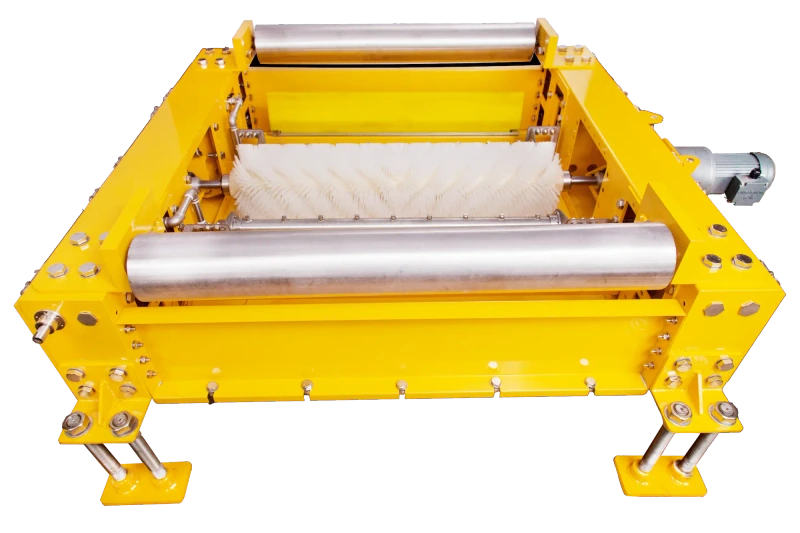
In mining, coal preparation, and wet aggregate processing plants, carryback adhering to the return belt is the primary cause of idler wear, belt misalignment, and material spillage along the conveyor line. Traditional single-blade belt scrapers frequently fail when handling sticky mud or clay due to rapid material buildup on the blade assembly. Modular conveyor belt cleaner boxes, such as the XLQSX-710 system, solve this challenge by integrating multiple cleaning components into a single enclosed system engineered for wet and sticky conditions.
1. Four-Stage Integrated Cleaning Mechanism (Spray-Brush-Scrape)
The core innovation of the cleaner box lies in replacing single-point scraping with a continuous physical and mechanical cleaning sequence:
- Primary Polyurethane Cleaner: Tightly contacts the lower surface of the return belt to strip heavy bulk material carryback, relieving mechanical load on subsequent stages.
- Stainless Steel Spray Assembly: Employs water sprays to saturate and moisten dry fine particles or sticky residue, softening the material and weakening its adhesion to the rubber belt.
- Motorized Rotary Brush Cleaner: Driven by a 380V/50Hz 3-phase AC gear motor, high-density bristles rotate rapidly against the belt travel direction to sweep out softened fines lodged in belt surface micro-cracks.
- Secondary Polyurethane Cleaner: Performs final precision scraping to wipe away residual water film and slurry, delivering a dry and clean belt back to the tail pulley.
The motor system supports electrical interlock control with the main conveyor drive to prevent dry friction wear during idle periods.
2. Mechanical Design & Material Specifications
Engineered for harsh industrial environments, the cleaner box incorporates key mechanical refinements:
- High-Performance Polyurethane Blades: Formulated for superior wear resistance, hydrolysis resistance, and chemical stability without causing cover wear to the belt. Features a quick-blade-change pin mechanism allowing tool-free blade replacement.
- Spring Tensioning System: Provides automatic linear compensation as the blade wears or as the belt experiences transient pulsation, maintaining optimal contact pressure.
- Modular Enclosure & Hidden Brackets: Clean exterior geometry with concealed internal brackets minimizes material buildup zones. Threaded height-adjustment legs allow versatile mounting.
- Operational Capabilities: Rated for maximum belt speeds up to , with rotatable spray manifolds for precision spray pattern alignment.
3. Installation Standards & Commissioning Protocol
- Site Selection: Mount in a stable section of the return run free from excessive vertical belt flutter, ensuring adequate clearance for maintenance access.
- Pressure Roller Alignment: Temporarily remove the two top pressure belt rollers during positioning. Secure the cleaner box frame to the conveyor superstructure, then reinstall the pressure rollers to hold the belt flush against the cleaning elements.
- Drive Integration: Connect the brush shaft to the gear motor output using the flexible shaft coupler, secure all structural fasteners, and install the protective drive enclosure.
- Commissioning & Calibration: Conduct a trial run for at least 15 minutes. Check cleaning performance and adjust spring tensioners and spray nozzle angles to ensure uniform coverage and optimal scraping contact.
4. Operational Safety & Lifecycle Maintenance
- Explosion Safety Warning: This unit is non-explosion-proof and must not be operated in hazardous gas or dust environments. Maintain mandatory safety distances during live inspection.
- Shutdown Flushing: Immediately flush residual slurry from the brush bristles and hopper base with water upon conveyor shutdown to prevent material hardening and bristle damage.
- Electrical Protection: Equipping the brush gear motor with overload protection circuitry is mandatory. Inspect blade wear thresholds regularly and replace worn elements promptly.