
Chapter 1: Material Flow Detection Requirements and Core Value in Bulk Material Handling Systems
In modern industries such as mining, power generation, ports, cement and chemicals, the belt conveyor (Belt Conveyor) is the core equipment for continuous, high-capacity and efficient transport of bulk materials. However, on long-distance and heavily loaded conveying lines, the material flow state continuously affects the stable operation of the entire production line. Running an empty belt for long periods causes enormous waste of electrical energy and unnecessary equipment wear; conversely, if overloading, material blockage or material absence is not detected in time, it may cause belt slippage, longitudinal tearing, material spillage, or even the shutdown of downstream processes, resulting in major production accidents.
To achieve automated interlocking control, energy saving and cost reduction in the conveying system, real-time monitoring of whether material is passing on the belt (i.e., material flow state monitoring) has become an indispensable part of industrial automation control systems. The material flow detector (Material Flow Detector / Switch), also known as a material flow switch or belt material sensor, is precisely the key sensing device developed for such industrial requirements.
As a new generation of industrial-grade material flow state detection equipment, the XLLL-B material flow detector, with its high reliability, strong adaptability and precise signal response, plays the role of the "intelligent eye" of the conveying line under various harsh working conditions, providing solid technical support for enterprises to realize intelligent conveying and unmanned inspection.
Chapter 2: Working Principle and Structural Design of the XLLL-B Material Flow Detector
2.1 Mechanical Contact Linkage and Micro Switch Triggering Mechanism
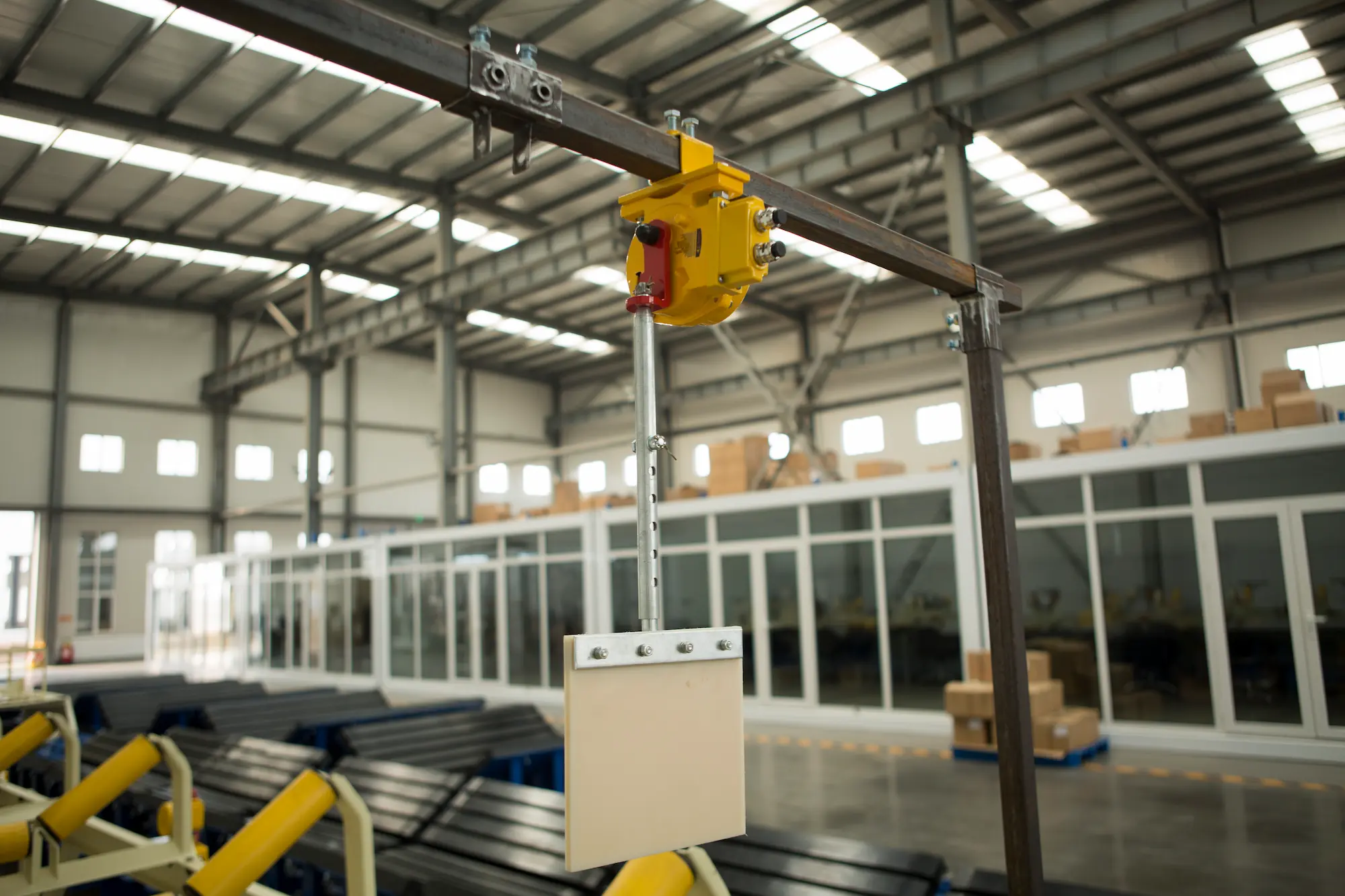
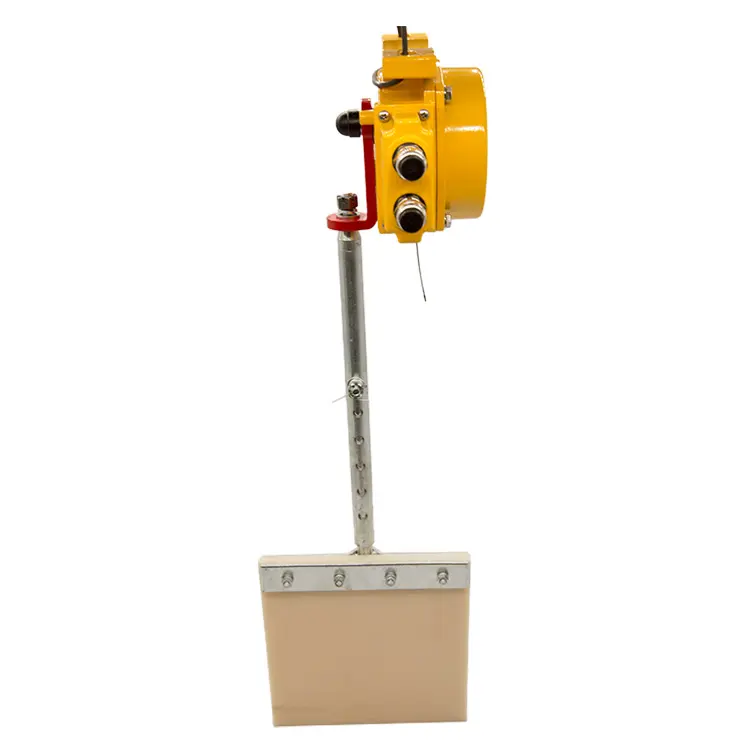
The XLLL-B material flow detector mainly adopts a mechanical swing arm (or swinging contact/wheel) to sense material flow. The device is installed above the belt conveyor, and its lower detection contact hangs freely at the position where the material passes on the conveyor belt.
- No-material state (empty load): When the belt runs empty, no material passes on the belt, and the detection contact maintains a vertical hanging position under the action of its own weight or the return spring. The internal micro switch remains in its initial contact state (normally open or normally closed) and outputs a "no material / empty load" signal to the control system (PLC/DCS).
- Material-present state (running): When material passes continuously on the belt, the incoming material piles up and pushes the detection contact to deflect forward (or to both sides) by a certain angle. When the swing angle reaches the preset actuation threshold (usually adjustable from 10° to 30°), the internal cam mechanism drives the high-sensitivity micro switch, the contact state flips, and a "material present / running" dry contact signal is output.
- Reset process: When material passage is finished and the belt returns to empty load or stops, the contact quickly returns to its vertical initial position under its own weight or spring restoring force, and the micro switch resets.
2.2 Strengthened Structural Design Features
In order to withstand the erosion of high-impact and highly abrasive materials such as mine ore, coal and cement clinker, the XLLL-B has been comprehensively optimized in its structural design:
- High-strength impact-resistant swing arm: The detection rod and wheel are made of wear-resistant alloy or flexible polymer anti-corrosion material, which not only ensures a sensitive response to material thrust, but also effectively buffers the strong impact of large lumps of material, preventing mechanical fracture.
- Sealed, dust-proof and corrosion-resistant enclosure: The enclosure is made of precision die-cast aluminum alloy or stainless steel, with a corrosion-resistant spray coating on the surface. The protection rating is as high as IP67, and the internal key electrical components are completely sealed against dust and water, preventing poor contact caused by dust accumulation and moisture ingress.
- Dual-bearing reinforcement and adjustable angle mechanism: The transmission shaft is supported by double sealed bearings and rotates smoothly and freely; an internal actuation angle adjustment device allows users to flexibly adjust the triggering sensitivity according to material thickness, particle size and belt line speed.
Chapter 3: XLLL-B Core Technical Parameters and Performance Advantages
To help engineers and purchasing staff precisely match on-site requirements, the table below lists the main technical specifications of the XLLL-B material flow detector:
| Technical Parameter | Specification / Performance Description |
|---|---|
| Product Model | XLLL-B series material flow detector / material flow switch |
| Contact Capacity | AC 220V/380V, 5A / 10A |
| Contact Configuration | 1 set NO+NC (1NO+1NC) or 2 sets NO+NC (2NO+2NC) |
| Actuation Angle | Continuously adjustable 10° – 30° (factory setting approx. 15°) |
| Limit Deflection Angle | 75° (with over-travel protection to prevent damage from strong impacts) |
| Protection Rating | IP65 / IP67 (suitable for outdoor rainstorm and dusty environments) |
| Ambient Temperature | -35°C to +75°C |
| Relative Humidity | ≤ 95% RH (at +25°C) |
| Reset Mode | Automatic reset (gravity self-reset / spring assisted) |
| Applicable Media | Bulk materials such as coal, ore, limestone, coke, grain and cement clinker |
3.1 Key Performance Advantages of the XLLL-B
- Fast response without false alarms: The unique mechanical damping and angle adjustment structure effectively filters out jitter caused by belt vibration, ensuring that the signal is triggered precisely only when material actually passes.
- Interlocking control and energy saving: It can realize intelligent interlocking with dust removal systems, spray sprinkling dust suppression devices, feeders and downstream conveyors. Dust suppression and spraying are started only when material is present, achieving significant water and electricity savings.
- Extremely long service life: High-quality micro switches combined with wear-resistant contacts allow more than 1 million switching operations, greatly reducing the frequency of maintenance and replacement.
Chapter 4: Applications of the Material Flow Detector in Typical Industrial Scenarios
The XLLL-B material flow detector is widely used in various continuous bulk material conveying systems. The application focus in different industries is as follows:
4.1 Coal Mine and Thermal Power Plant Conveying Systems
In coal faces, coal preparation plants and coal conveyor galleries of thermal power plants, belt conveyors carry large volumes of coal. Material flow detectors are often installed below feeders or on transfer station belts:
- Feed interlocking: When material absence occurs on the upstream belt (for example, a blocked feed bin), the XLLL-B detects the no-material signal and transmits it to the PLC in time, so the control system can automatically pause downstream equipment or issue an early warning, avoiding imbalance in the coal blending ratio.
- Automatic dust removal and suppression: Interlocked with the dust suppression spraying system, spray dust suppression is started only when a coal flow actually passes, reducing water waste and preventing the coal from becoming too wet.
4.2 Mining, Ore Dressing and Metallurgical Sintering Systems
In metal mines (iron ore, copper ore, gold ore, etc.) and metallurgical plants, the materials are mostly hard, large-lump and high-density ore and slag.
- Impact protection: The XLLL-B has specially strengthened contact wear resistance and impact resistance, and can still maintain stable deflection and reset under the frequent impact of large ore lumps.
- Anti-blockage and anti-spillage: Used together with blockage switches at the transfer chute, it monitors the material accumulation state at the discharge outlet in real time, ensuring uninterrupted high-load continuous operation.
4.3 Building Materials, Cement and Port Bulk Cargo Handling
Port bulk cargo terminals (shiploaders, unloaders, stacker-reclaimers) and cement plant conveying lines are characterized by large conveying capacity, high belt line speed and harsh outdoor environments (sea breeze and salt spray, rainstorm and dust).
- The high protection rating (IP67) and anti-corrosion coating of the XLLL-B enable it to easily cope with high salt spray at the seaside and outdoor rainstorm erosion, accurately indicating the material-present/material-absent state of the conveying line and enabling remote centralized automated scheduling.
Chapter 5: Installation Guide, Commissioning Steps and Routine Maintenance Specifications
5.1 Installation Position and Fixing Method
- Selection of installation position: A location where the belt runs smoothly, is less affected by material drop impact and has a fixed material flow direction should be selected. It is usually installed on a straight conveying section 5-10 meters behind the feed opening, avoiding concave curve sections or locations where the belt jumps violently.
- Fixing bracket by welding/bolting: Build a sturdy crossbeam bracket above the conveyor frame and fix the XLLL-B detector at the exact center of the bracket.
- Contact position adjustment: Adjust the installation height of the detector so that when the detection contact hangs freely, the bottom of the contact is about 30-50 mm away from the surface of the empty belt (fine-tuned according to belt thickness and material particle size), ensuring that it does not touch the belt when there is no material and that material can smoothly push the contact to deflect 15°-20° when material is present.
5.2 Commissioning and Electrical Wiring Steps
- Electrical wiring: Referring to the equipment wiring diagram, pass the control cable through the waterproof threaded cable entry, connect it to the NO (normally open), NC (normally closed) and COM (common) terminals of the internal micro switch, and tighten the waterproof sealing nut to ensure sealing performance.
- Manual simulation test: With the power off, push the detection contact by hand to deflect it, listen for a clear "click" actuation sound from the micro switch, and use a multimeter to measure whether the contact on/off state is normal.
- Trial run with material: Power on and start the belt conveyor for a trial run with material, and observe the deflection angle of the contact and the signal output when material passes. If the signal is not triggered when the material flow is small, appropriately reduce the internal actuation angle threshold or slightly lower the installation height.
5.3 Routine Maintenance and Troubleshooting
- Regularly remove dust and foreign objects: Periodically check whether there are entangled objects (such as plastic rope, iron wire, etc.) or accumulated material wrapping around the detection contact, and keep the contact swinging smoothly.
- Check sealing performance and wiring screws: Check once a quarter whether the sealing rubber ring of the junction box has aged and whether the wiring bolts are loose, to prevent moisture ingress.
- Mechanical wear inspection: If the contact length is shortened due to long-term wear by highly abrasive materials, the wear-resistant contact accessory should be replaced in time or the installation height adjusted.
Chapter 6: Summary and Selection Recommendations
As a "sensory element" in the automation control system of bulk material conveying, the stable performance of the material flow detector directly affects the operating efficiency and energy-saving and emission-reduction results of the entire conveying production line. With its robust and durable structure, precise and flexible triggering response and excellent environmental adaptability, the XLLL-B material flow detector has become the ideal choice for material conveying safety assurance in mining, power, port, cement and other industries.
Selection recommendations:
- Choose the contact according to material characteristics: For ore-type materials with large lump size and strong impact force, it is recommended to choose a thick-walled wear-resistant alloy contact; for light materials (such as grain and wood chips), a lightweight and sensitive contact is preferable.
- Choose the contact configuration according to control requirements: If only a single signal channel is needed for connection to the PLC, choose the single-set contact type; if signals must be output simultaneously to an on-site alarm and the central control room, the double-set contact type (2NO+2NC) is recommended.
- Look for original factory quality and qualifications: When purchasing, choose a manufacturer with ISO quality system certification and professional qualifications for manufacturing industrial safety switches, to ensure long-term reliable operation of the product under extreme working conditions.