
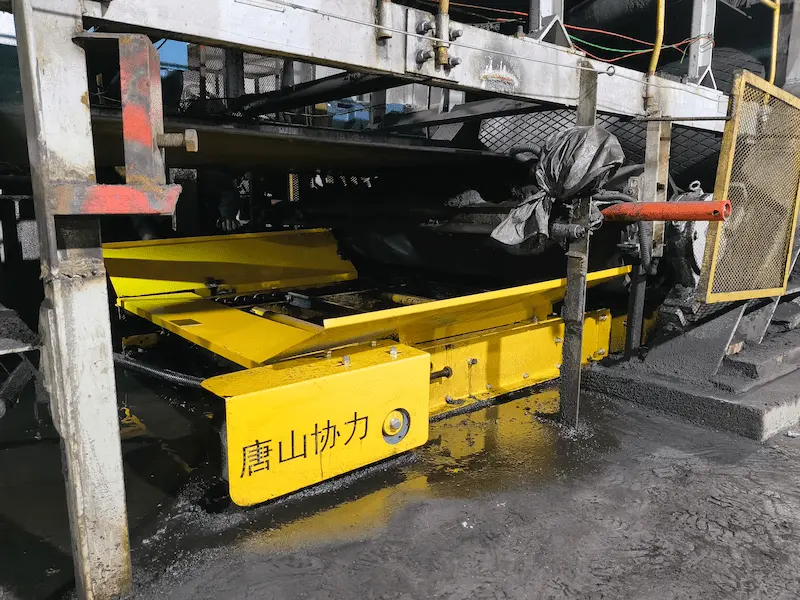
In modern large-scale coal preparation plants, thermal-coal washing workshops, mine shaft transfer trestles, and port storage and transport systems, the belt conveyor is the "main conveying artery" of the entire production process. From raw coal receiving, dense-medium separation, and flotation dewatering through to middlings and clean coal loading, the continuous operation of every production unit and the overall throughput of the entire plant are directly constrained by the stable availability of the belt conveyor network.
However, under long-term high-load conveying conditions, because raw coal moisture content fluctuates widely, coal sludge is strongly cohesive, and the content of fine particles is high, the working surface of the belt inevitably retains a layer of highly viscous residual slurry that is extremely difficult to shed after the belt is discharged at the discharge pulley. When the belt enters the return branch at high speed, this residual material continuously drops and scatters in the head return zone and beneath the elevated trestle bridge gallery. Over time, thick, wet, sticky layers of accumulated coal and coal sludge form at the bottom of the conveyor frame, below the bend pulley, and on the steel beam walkways of the trestle.
For a long time, the bulk material industry has generally relied on an extensive "manual mucking-out" mode for routine housekeeping. Workers have to wear cumbersome personal protective equipment, crawl into the low, narrow, dust-laden, dimly lit bottom of the conveyor frame, and even enter confined spaces, holding shovels, pry bars, or high-pressure water guns to scrape out and wash away the caked coal sludge bit by bit. This traditional working mode involves not only extreme labor intensity and extremely low operating efficiency, but also constantly harbors major safety risks such as falls from height, entanglement in rotating machinery, and asphyxiation due to oxygen deficiency. More seriously, washing coal sludge is rich in free moisture and sulfides; when wet sludge tightly wraps and adheres to the trestle steel structure supports and ground beams over long periods, it triggers severe chemical and electrochemical acidic corrosion, greatly shrinking the actual service life of the main load-bearing trusses and planting enormous hidden dangers for the intrinsic safety of the coal preparation plant.
Therefore, breaking away from "manual work and shutdown-based clearing" and introducing a fully enclosed chain-plate automatic material recovery system aimed at the head discharge point and the bottom spillage zone, so as to achieve "on-site collection, fully enclosed lifting, and 100% automatic return" of bulk spillage and scraped residue, has become a key breakthrough for modern heavy-industry bulk storage and transport systems to improve intrinsic safety and realize unmanned, green operations.
I. Formation Mechanism of Conveyor Bottom Accumulation and Return-Run Carryback and the Chained Hazards Involved
To fundamentally eliminate the problem of sludge accumulation in trestles, one must first analyze in depth the physical generation path of return-run carryback and bottom accumulation, as well as the multiple chains of damage it inflicts on conveying equipment:
1. Interfacial Capillary Action and Residual Material in the Blind Zone of the Secondary Scraper
During receiving and transport, raw coal is compacted by gravity, and fine coal particles and moisture form extremely strong capillary adsorption water bridges on the micro-porous rubber surface of the belt. Even if the head is equipped with a well-performing primary polyurethane cleaner, its main task is only to tangentially strip 80%–90% of the thick material in the surface layer; the remaining dense sticky mud and fine coal slurry adhere to the belt surface and pass through the gap of the primary scraper blade. When they pass the secondary fine-scraping alloy cleaner or the bend pressure roller, the fine coal sludge is scraped off under high pressure. Because the installation space of the secondary cleaner is compact, the scraped slurry often cannot be thrown directly into the main discharge hopper, but instead drops straight down onto the frame base plate and the trestle floor.
2. Return-Run Belt Flutter and Line-Wide Dispersed Spillage
As the return belt continuously passes at high speed through dozens of return idler sets, the belt is subjected to periodic tension fluctuations and mechanical vibration, and the hardened coal crust remaining on the non-working surface or on the edges is shattered into particles, which then fall continuously in a "snowfall-like" manner beneath the entire inclined elevated trestle walkway, several tens or even hundreds of meters long.
3. Rapid Acidic Corrosion of Trestle Steel Structures and Mechanical Load-Bearing Damage
Many coal preparation plants overlook the corrosion mechanism that accumulated sludge exerts on civil steel structures. Raw coal generally contains sulfide components such as pyrite (iron disulfide ). In a closed trestle environment that is humid, warm, and poorly ventilated, the wet coal sludge adhering to the surface of the steel structure undergoes violent oxidative hydrolysis reactions with oxygen in the air, generating highly corrosive electrolyte films of sulfurous acid and dilute sulfuric acid:
This acidic water film directly attacks the trestle I-beam girders, channel-steel transverse cross bracing, support leg column bases, and floor embedded parts, inducing severe electrochemical hydrogen-evolution corrosion and pitting perforation. Sludge that is not cleaned in time can reach a thickness of tens of centimeters and bury the load-bearing steel beams, causing high-performance anti-corrosion coatings to blister and peel off within a few years. The effective cross-section of the steel beams is thinned by corrosion and the bending and torsional stiffness is greatly reduced, so that the entire suspended trestle faces an irreversible risk of structural fatigue instability under heavy-load vibration.
II. Three Major Pain Points and Safety Red Lines of Traditional Manual Mucking-Out
The long-standing practice of relying on manual cleaning of bottom accumulation exposes extremely severe contradictions under modern industrial safety and occupational health standards:
1. Harsh Confined-Space Working Conditions and Hidden Risks of Fatalities
The return branch of a belt conveyor is usually only 0.4 m to 0.8 m above the ground, and the frame cross beams are interwoven with pull cords and idlers along the line, making it a typical narrow, semi-enclosed or confined space. During mucking-out, workers must lie prone or crawl on their knees into the bottom of the frame; the slightest carelessness may result in entanglement in a running idler or a crushing accident in which a limb is caught and pinched by the belt. At the same time, high concentrations of airborne coal dust and humid sulfide gases diffuse through the enclosed corridor, and long-term work easily leads to severe pneumoconiosis and chronic respiratory damage.
2. Secondary Equipment Accidents Caused by Manual High-Pressure Water Washing
To speed up cleaning, sites often use large-diameter high-pressure water guns to blindly wash the bottom steel plates. The high-pressure water jet inevitably penetrates the bearing seal cavities of the lower idlers, the junction boxes of the pull-cord switches, and the interiors of the deviation switches, causing emulsification and loss of bearing grease, seizure and flattening of bearings, and even short circuits that burn out electrical circuits. More seriously, the overflowing washing water with a high solids content flows along the inclined trestle into the electrical distribution room or the sedimentation tank, causing severe water and coal spillage and secondary pollution in the workshop.
3. High Unplanned Downtime Costs and Labor Contradictions
Large-area mucking-out usually requires a power-off and shutdown request for the entire line, and each cleaning takes several hours, directly interrupting the main process production of the coal preparation plant. As the demographic dividend fades and safety access standards for high-risk industries become increasingly strict, front-line mucking-out positions face serious labor shortages and an aging workforce.
III. Working Principle and Core Mechanical Architecture of the Chain-Plate Material Recovery Device
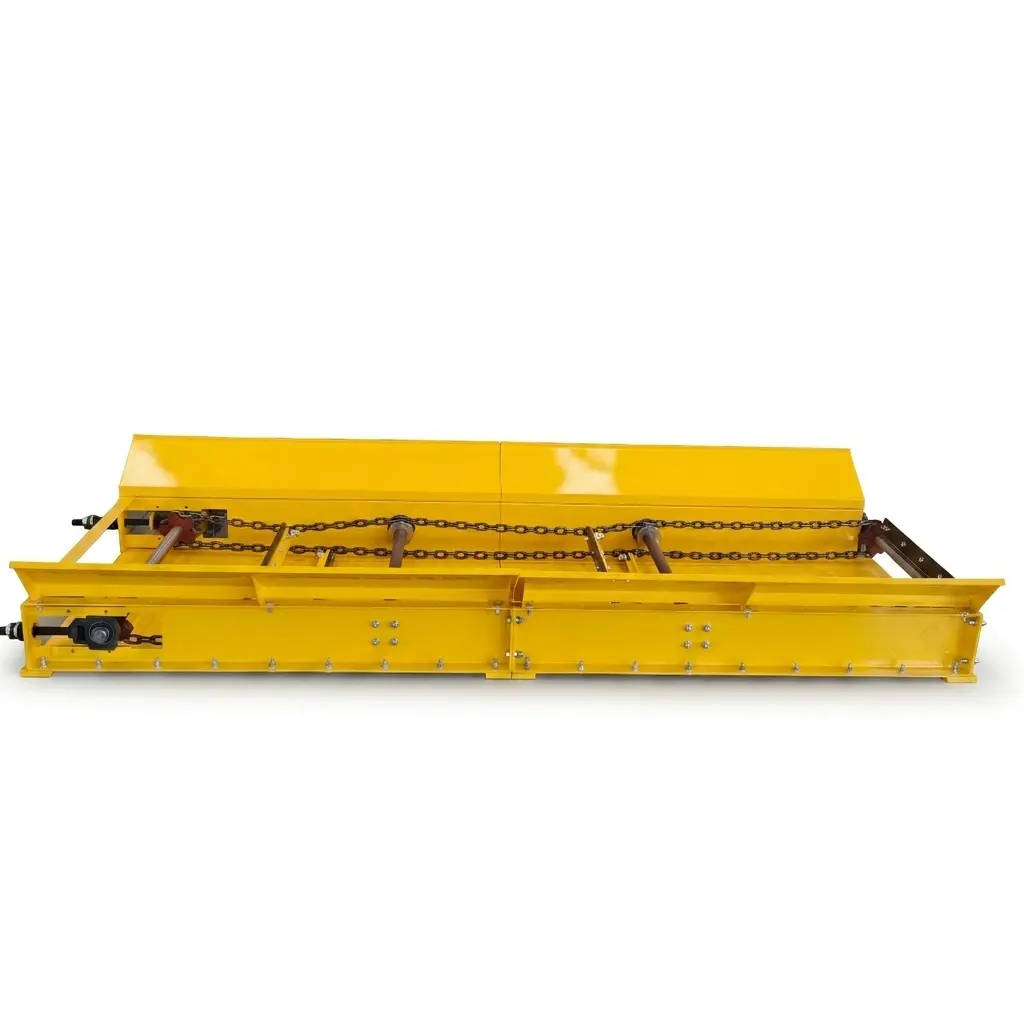
In order to completely end the passive situation of "exchanging human labor for cleanliness", the chain-plate type material recovery device has emerged. It is a low-speed, high-torque, fully enclosed miniature scraper-type material lifting and return system designed specifically for the material drop zone below the secondary cleaner and for the receiving section at the conveyor head.
1. Structural Assembly and Modular Layout
The whole device presents a long, thin box-type structure, with the main body arranged horizontally or at a slight inclination directly below the secondary cleaner of the belt conveyor head working face:
- Fully enclosed guided collecting hopper: the wide opening of the receiving hopper faces exactly the falling parabola of the secondary scraper blade, so that all scraped viscous coal sludge, water-bearing fines, and debris are received in a 100% enclosed manner, eliminating material splash-out;
- Heavy-duty conveyor trough and ultra-high molecular composite liner: the trough body is precisely cut and formed from high-strength structural steel, with anti-deviation guide rails arranged on both sides. The bottom of the trough is tightly laid with ultra-high molecular weight polyethylene (UHMWPE) or wear-resistant alloy composite liner. The extremely low dynamic friction coefficient and hydrophobic self-lubricating performance of UHMWPE completely eliminate the problem of highly viscous wet coal sludge caking and hanging on the trough bottom;
- Die-forged high-strength alloy traction chain and heavy-duty scraper plates: a special corrosion-resistant die-forged alloy chain is used as the traction component, matched with several thick-walled heavy-duty wear-resistant bent scraper plates (chain plates), providing extremely high breaking tensile strength and impact fatigue limit;
- Flameproof direct-coupled drive assembly and tensioning unit: driven directly by a large-ratio flameproof motor and a shaft-mounted hardened-tooth-surface gear reducer, with a floating screw-slider tensioning mechanism at the tail end, allowing the chain pre-tension to be finely adjusted at any time.
2. On-Site Closed-Loop Return Working Mechanism
- In-situ scraping and collection: the viscous coal sludge stripped from the belt working surface falls directly into the enclosed trough and does not come into any physical contact with the external trestle steel structure;
- Low-speed reverse conveying: the transmission chain plates, dragged by the motor, slide uniformly along the trough bottom at a stable slow speed of 0.12 m/s, smoothly pushing the high-consistency sludge forward and upward along the trough;
- Self-return into the main material flow: the discharge end of the recovery device extends and cantilevers into the interior of the main discharge chute or above the next-stage receiving hopper. The material pushed by the scraper plates to the head falls off by gravity at the turning discharge outlet and blends smoothly into the falling main raw coal flow. The whole process requires no additional water washing, thereby realizing "100% automatic cleanup of bottom spillage and return into the flow".
IV. Core Technical Parameter Matrix and Equipment Selection Matching Table
To facilitate engineering design and equipment selection, the following table summarizes the standard technical parameter matrix of the chain-plate material recovery device:
| Key parameter item | Official standard technical indicator / performance specification | Industrial application selection notes and design margin |
|---|---|---|
| Standard equipment name | Chain-Plate Type Material Recovery Device | Dedicated to automatic on-site recovery of secondary scraper discharge and spillage beneath the conveyor |
| Ambient temperature adaptation range | -20°C to +50°C | Meets all-weather operation of extremely cold open-air trestles in the north and humid hot coal preparation workshops in the south |
| Working power supply and frequency | AC 380V (±10%), 50/60 Hz three-phase industrial power | Compatible with standard power distribution networks of mines and coal preparation plants |
| Drive motor power | 0.75 kW to 1.5 kW (selected according to the effective recovery length) | Ultra-low operating power consumption design, saving more than 85% of electricity compared with traditional water-flushing pumps |
| Rated chain-plate running speed | Approx. 0.12 m/s (ultra-low-speed smooth sliding design) | Avoids high-speed material throw-out and severe wear, greatly extending the service life of mechanical moving components |
| Enclosure protection rating of the whole machine | IP54 / IP55 (fully enclosed dust-proof and splash-proof design) | Isolates immersion by hot humid coal slurry and ingress of high-concentration external coal dust |
| Applicable conveyor belt width range | B = 650 mm to 2000 mm (modular assembly customization supported) | Trough width perfectly matches the clear space dimensions of belt conveyor frames of all specifications |
| Trough bottom liner material configuration | Ultra-high molecular weight polyethylene (UHMWPE) / wear-resistant and acid-resistant alloy steel plate | Extremely smooth surface, resistant to acidic electrolytic water corrosion, eliminating coal sludge adhesion |
| Traction chain form | Special die-forged wear-resistant alloy sleeve roller chain / high-strength plate chain | Tensile safety factor ≥ 6, no chain breakage under momentary foreign-object squeezing |
V. Intelligent Closed-Loop Control Logic and Automated Operating Sequence
The chain-plate material recovery device must achieve deep electrical interlocking with the main belt conveyor and its cleaning system in order to deliver its unmanned intelligent protection performance:
- "Reverse sequential start and delayed stop" process interlocking sequence
- Advance pre-start: 10 to 15 seconds before the main belt conveyor starts, the main control system (PLC) starts the chain-plate material recovery device first, bringing it into a stable rotating cycle so as to ensure that the receiving trough is unobstructed;
- Delayed tail-end sweeping: after the main conveyor stops and is de-energized, fine residual material still drips and hangs below the primary and secondary cleaners at the head. The control system automatically keeps the chain-plate recovery device running with a delay of 3 to 5 minutes, until the wet coal sludge remaining in the trough has been completely scraped clean and discharged into the main chute; only then is the power automatically cut off, preventing residual sludge from solidifying and caking inside the trough.
- Real-time current and torque monitoring with intelligent reverse unjamming
The motor control circuit is equipped with an intelligent overload protector and a current transformer. If, during coal conveying, hard gangue or angle-iron debris occasionally penetrates the cleaner and falls into the trough, jamming the chain plates, the motor operating current will rise rapidly within 0.3 seconds:
- The system instantly identifies the stall fault and automatically cuts off the forward circuit within 0.5 seconds;
- The controller automatically triggers a self-healing unjamming cycle of "short-time reverse inching retraction of 200 mm -> a second forward high-force impact attempt";
- If the jam cannot be cleared after 3 consecutive attempts, the system immediately locks out and stops, and pushes an audible and visual alarm to the upper computer, strictly preventing motor burnout or chain breakage.
- Discharge outlet anti-backup material blocking interlock A material position detection sensor is installed at the discharge end of the recovery machine. If severe blockage occurs in the main discharge chute and material accumulates and backs up to the discharge outlet of the recovery machine, the system instantly locks out the operation of the recovery machine, preventing a large amount of material from squeezing and bursting the box body at the head of the recovery machine.
VI. Standardized On-Site Installation, Long-Term Trestle Anti-Corrosion, and Safe Operation and Maintenance Guide
To ensure that the chain-plate recovery device delivers its effectiveness stably over the long term and to completely eliminate the risk of trestle corrosion, on-site implementation must strictly comply with the following working specifications:
1. Spatial Positioning and Lap-Joint Sealing Specifications
- Level and inclination calibration: the trough of the recovery device should be firmly suspended horizontally or at an inclination not greater than 15° on the load-bearing channel steel below the head. The receiving hopper opening must fully cover the outer edge of the secondary scraper blade and extend outward by more than 100 mm, ensuring that all splashed scraped material falls into the hopper;
- Flexible sealing skirt: polyurethane acid-resistant dust-proof soft curtains must be installed between the hopper edge and the conveyor frame to form a slightly negative-pressure enclosed space, completely cutting off the physical channel through which water vapor and airborne coal escape onto the trestle walkway.
2. Closed-Loop Long-Term Anti-Corrosion Treatment of Trestle Steel Structures
Before equipment installation, all old hardened coal sludge previously accumulated on the trestle steel structure must be thoroughly removed, and the exposed steel beams must be abrasive-blasted to remove rust; then an epoxy zinc-rich primer and an acid-resistant polyurethane heavy-duty anti-corrosion topcoat should be re-applied. Because the chain-plate recovery device achieves 100% enclosed interception of bottom spillage, the trestle steel structure is completely freed from long-term immersion erosion by the acidic coal sludge water film, and the design service life of the main load-bearing truss of the trestle can be effectively extended several times over.
3. Routine Maintenance and Inspection Procedures
- Periodic chain tightness verification: during monthly inspections, check the sag of the chain on the slide rail through the inspection hole, and use the tail tensioning nut to keep the chain always in the optimal tensioned state, preventing the chain from being too loose (which causes tooth jumping and rail biting) or too tight (which causes abnormal pin shaft wear);
- Lubrication and sealing inspection: every quarter, apply composite calcium sulfonate extreme-pressure grease to the drive main shaft bearing housings and sliding bearings, and check the sealing performance of the skeleton oil seal at the output shaft end to strictly prevent cement slurry from penetrating into the bearings;
- Strictly observe the safety maintenance red line: even if the chain-plate recovery device runs smoothly, any operation involving opening the protective cover plate, servicing the chain, or removing large jamming foreign objects must strictly implement the "power-off, tag-out, lock-out (LOTO)" system, and the work may only be started after the local safety emergency stop button has been pressed and the power supply has been cut off, eliminating illegal live maintenance.
By deploying chain-plate material recovery devices at the key material drop nodes of the belt conveyors on the coal handling line, enterprises not only achieve "source interception and fully automatic return" of bottom coal and sludge accumulation, but also completely eliminate manual confined-space mucking-out operations in high-risk, harsh environments, effectively blocking the long-term chemical corrosion of acidic coal sludge on the steel structure of elevated trestles, and building an intrinsically safe, efficient, and environmentally friendly intelligent conveying moat for modern mines and coal preparation plants.