
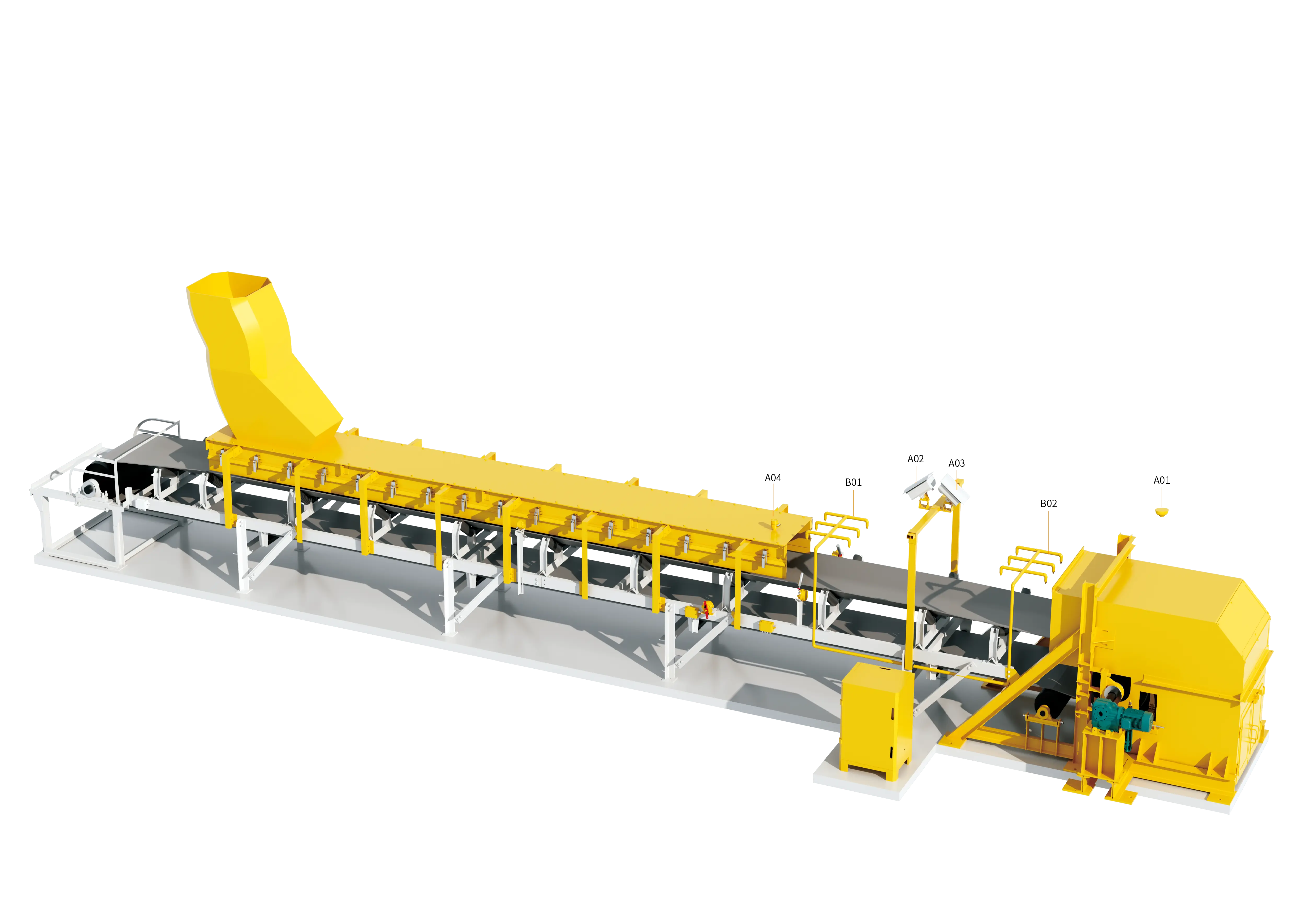
In coal mining and coal preparation plants, coal conveying galleries of thermal power stations, steel and metallurgical coking plants, cement and building-materials clinker preparation lines, and coastal bulk cargo terminals, belt conveyors perform round-the-clock, high-throughput material transfer duties along the backbone of bulk material storage and transport. Because bulk materials such as coal, coke, iron ore fines, and limestone are highly susceptible to severe particle breakage during high-speed movement and high-drop transfer, large quantities of respirable fine dust are violently released and dispersed at transfer chute outlets and at the belt receiving sections. Dust levels above limits not only cause severe deterioration of the working environment and threaten the respiratory health of frontline operators, but high concentrations of combustible coal dust also conceal a devastating risk of dust explosion.
At the same time, on long-distance enclosed conveyors operating under high summer temperatures or handling high-sulfur, high-volatile raw coal, heat accumulated inside the material pile can easily trigger smoldering oxidation and even open-flame spontaneous combustion accidents. For a long time, industrial sites have mostly relied on conventional “always-on mechanical water spray piping” or rough manual water valves to suppress dust and reduce temperature. However, this non-intelligent conventional approach has enormous engineering pain points: on the one hand, “spraying with no material on the belt” causes an astonishing waste of industrial water, while accumulated water leakage accelerates corrosion of the frame and leads to belt slippage and misalignment; on the other hand, if the spray volume is out of control and the material moisture content becomes too high, not only does the calorific value of downstream power plant boilers drop sharply and transport energy consumption increase, but wet and sticky material also adheres to the chute liner plates and return idlers, inducing frequent material blockage, poor discharge, and cleaner failure with material carryback.
Therefore, moving away from “rough always-on water supply” toward a Belt Conveyor Intelligent Monitoring and Spraying System in which “multi-dimensional precise condition sensing (sensing unit)” and “targeted, graded, adaptive regulation (spray unit)” work in deep coordination has become the core technical path for modern bulk material storage and transport systems to achieve environmental compliance, safe fire prevention, and cost reduction with efficiency gains.
1. Overall Architecture and Closed-Loop Control Philosophy of the Intelligent Spraying System
The intelligent monitoring and spraying system completely abandons the traditional “passive response” governance logic and builds an adaptive closed-loop control architecture that integrates “multi-dimensional sensing of environmental conditions and material flow”, “comprehensive evaluation by an edge microcontroller”, and “on-demand graded dynamic release of micro-fog and spray”.
Physically, the entire system consists of three core levels: the “A sensing unit matrix” arranged along the material transport path and in the surrounding space, the “B spray unit mechanism” that performs multi-state fluid release, and the “intelligent electrical control hub” integrating a PLC, industrial communication buses, and valve actuator drives. The system continuously collects the passage status of material above the belt, the geometric cross-sectional width of the material load, the surface and internal temperature, the inherent moisture content of the material, and the concentration of suspended dust in the surrounding ambient air. Based on a multi-sensor fusion model, the central control algorithm analyzes the current dust generation intensity and spontaneous combustion risk level at nanosecond resolution, automatically calculates the optimum water-to-air ratio and spray flow rate, and drives negative-pressure ultrasonic micro-fog nozzles or dual-layer high-flow spray headers to perform precise work, truly achieving “spray when material is present, stop when it is absent, increase micro-fog when dust is heavy, apply spray cooling when temperature is high, and reduce the dose when moisture is sufficient”.
2. Core Sensing Layer: Four-Dimensional Monitoring Mechanisms of the Sensing Units (A Units)
To achieve on-demand precision spraying, the system must first rely on an all-round, highly sensitive multi-sensor detection matrix to dynamically scan the conveyor belt and its surrounding space:
1. Material Flow Sensing Unit (Material Presence and Cross-Sectional Load Sensing)
- Monitoring principle: contact-type swing-arm encoder speed sensors, microwave Doppler radar detectors, or ultrasonic material level scanners are installed upstream of the receiving section or above the transfer chute outlet.
- Core function: real-time monitoring of whether material is passing on the belt working surface, together with the transverse accumulation width of the material load and the instantaneous cross-sectional load. The material flow signal serves as the preconditioning admission switch for the entire spraying system — when the belt runs empty or material feed stops, the system forcibly locks all water supply lines, completely eliminating from the source the water accumulation and seepage, structural corrosion, and empty-belt slippage accidents caused by “spraying without material”.
2. Temperature Sensing Unit (Early Warning of Material Spontaneous Combustion and Abnormal Temperature Rise)
- Monitoring principle: composed of non-contact dual-band infrared thermometers, infrared thermal imaging array sensors, or distributed laser temperature-sensing optical fibers, installed in the material-facing zone of the transfer chute inner wall and directly above the belt at the discharge outlet.
- Core function: high-speed continuous scanning at 0.1-second intervals of the surface and hidden hot spots of material flowing rapidly with the belt. When raw coal and similar materials undergo internal oxidation and heat accumulation, when smoldering coal lumps from mined-out areas are mixed in, or when mechanical friction generates local abnormal high temperatures (exceeding the 60°C–80°C warning line), the temperature sensing unit instantly outputs an over-temperature alarm signal, providing the baseline judgment for triggering heavy-duty spray extinguishing and cooling.
3. Moisture Content Sensing Unit (Inherent Humidity and Over-Wetting / Caking Prevention Monitoring)
- Monitoring principle: high-frequency microwave transmission attenuation method or near-infrared spectral reflectance online moisture analyzers, mounted non-contact above the stable material passage section.
- Core function: real-time measurement of the inherent free moisture content (moisture percentage) of the material before it enters the transfer point. If the material itself is already saturated with moisture (for example, high-moisture washed coal slime), the system automatically reduces or even shuts off the regular spray volume to prevent over-wetting from causing chute wall adhesion and blockage or downstream coal calorific value loss; only when the material is monitored to be in an extremely dry range prone to dust generation does the system calculate the make-up spray volume according to the shortfall.
4. Dust Concentration Sensing Unit (Online Quantification of Airborne Respirable Dust)
- Monitoring principle: high-protection explosion-proof dust transmitters based on laser scattering or charge induction principles are installed at the transfer chute discharge outlet, inside the dust collection hood, and in the core dust dispersion zone 3 to 5 meters downwind of the material drop point.
- Core function: all-weather continuous quantitative monitoring of PM2.5, PM10, and total suspended particulate (TSP) concentration values in milligrams per cubic meter (mg/m³) in the surrounding ambient air. The dust concentration signal is fed directly back to the control system as the closed-loop feedback control variable for adjusting spray droplet fineness and spray water pressure.
3. Execution and Release Layer: Multi-Modal Water-Fog Treatment Technologies of the Spray Units (B Units)
Conventional watering usually uses coarse-orifice nozzles, with droplet diameters generally above 1000 micrometers (1 mm), whereas dust particles floating in the air are usually between 1 and 50 micrometers in diameter. According to the streamline collision theory of fluid mechanics, a large droplet generates a strong airflow shielding layer around itself as it falls, so fine dust simply bypasses the droplet and drifts away with the airflow instead of being captured. The intelligent spraying system adopts a coordinated dual-mode architecture of micro-fog and spray to achieve precise treatment:
1. Micro-Fog Dust Suppression Unit (Sub-Micron-Scale Fog Cloud Dust Capture)
- Equipment configuration: composed of negative-pressure induced ultrasonic atomizing nozzles, stainless steel two-fluid (air-water mixture) high-pressure nozzles, or micron-level dry-fog spray boxes, densely installed inside the transfer chute and around the dust capture hood at the outlet.
- Technical principle: high-pressure water and clean compressed air are sheared and collided at high speed inside the nozzle cavity, or a special negative-pressure resonance generator is used, to produce dense ultra-fine water fog droplets with a diameter of only 1 micrometer to 10 micrometers. The particle size of the micro-fog is fully comparable to that of airborne respirable dust particles.
- Dust removal characteristics: because the fog droplets are extremely fine and have very low surface kinetic energy, they can remain suspended for a long time inside the enclosed receiving space of the transfer chute, forming a dense “micro-fog dust capture cloud”. After colliding with dust particles, the micro-fog rapidly coalesces and agglomerates under surface tension, settles naturally under gravity, and is carried away with the material. The entire process only wets the dust without soaking the material surface (the moisture increment of the material is strictly controlled below 0.1%), thoroughly resolving the contradiction between dust removal and material adhesion, caking, and reduced calorific value.
2. Spray Unit (High-Flow Targeted Extinguishing, Cooling, and Wetting)
- Equipment configuration: dual-layer wide-angle solid-cone anti-clogging nozzles, fan-shaped high-pressure impact spray headers, and dedicated electric self-controlled high-frequency solenoid valve groups, installed across and above the material-facing plate inside the receiving chute and over the belt carrying surface at the discharge outlet.
- Technical principle: upon receiving a hard trigger command for over-temperature, a sudden severe material impact, or a heavy dust outbreak, the high-pressure water supply line opens fully in an instant, releasing a high-speed solid water curtain with droplet diameters of 100 to 300 micrometers.
- Functional characteristics: it mainly undertakes the tasks of emergency cooling and fire fighting, deep penetration and wetting, and fire prevention for heavy-load discharge. The powerful kinetic energy of the water curtain directly penetrates the tumbling material layer, rapidly extinguishes smoldering hot spots, absorbs a large amount of latent heat, and eliminates spontaneous combustion hazards in the initial smoldering stage.
4. Parameter and Operating-Condition Matching Matrix of the Core Units of the Intelligent Spraying System
To facilitate industrial design selection and solution matching, the following table systematically summarizes the technical characteristics of the key sensing and spraying units of the intelligent spraying system:
| System module | Core unit name | Key technical principle and sensing form | Optimal engineering installation position | Typical operating conditions and control function |
|---|---|---|---|---|
| A sensing unit | Material flow sensing unit | Contact-type follower speed-measuring wheel / microwave Doppler radar detection | Upstream of the conveyor receiving point or the steady belt section at the chute inlet | Accurately identifies belt loading and material load width; acts as the unconditional preconditioning interlock for spray activation |
| A sensing unit | Temperature sensing unit | Dual-band infrared radiation non-contact temperature measurement / infrared thermal imaging array | Inside the transfer chute drop point, directly above the material at the discharge outlet | Detects deep abnormal temperature rise and smoldering sparks; triggers the high-pressure high-flow spray fire-prevention interlock |
| A sensing unit | Moisture sensing unit | High-frequency microwave transmission attenuation / near-infrared multi-spectral absorption | Straight visible section of the belt at the feed end, aimed vertically at the material flow | Real-time quantitative measurement of inherent material moisture; dynamic quota calculation of make-up spray volume to prevent over-wetting and caking |
| A sensing unit | Dust sensing unit | Laser forward scattering measurement / triboelectric charge induction transmitter | Chute discharge outlet, dust collection return air outlet, and downwind dispersion zone | Millisecond-level feedback of airborne dust mass concentration; closed-loop regulation of micro-fog release volume and pipeline water pressure |
| B spray unit | Micro-fog dust suppression unit | Negative-pressure induced ultrasonic nozzle / compressed-air two-fluid atomization | Top and side walls of the enclosed chute cavity, and gaps of the dust-suppression damping curtain | Generates a 1–10 μm suspended dry-fog cloud that efficiently captures floating fine dust, with a material moisture gain below 0.1% |
| B spray unit | High-pressure spray unit | Dual-layer wide-angle anti-clogging solid-cone nozzle / high-speed electric shut-off valve | Impact zone inside the chute, anti-impact section directly above the main receiving hopper | Instantly delivers a high-kinetic-energy water curtain for large-area wetting and cooling and for extinguishing smoldering fire points, ensuring equipment safety |
5. Closed-Loop Control Logic of “Four-Dimensional Dynamic Sensing + Millisecond-Level Variable-Frequency Spraying”
The entire intelligent monitoring and spraying system executes three-level progressive automatic regulation through an industrial-grade micro-control system:
- Level 1: Rigid interlock of material flow status (locked when no material) The material flow sensing unit returns signals in real time. If the conveyor belt is judged to be in an empty, material-free state or the main belt conveyor is shut down, the PLC immediately forces all electric valves of the water and air supply lines to close, stopping all spraying operations and eliminating unnecessary water consumption and return-belt slippage.
- Level 2: Dynamic closed-loop dust suppression based on moisture and dust (flexible micro-fog adaptation)
When the material flow sensing confirms that material is running, the system combines the data from the feed moisture analyzer and the dust sensors:
- If the material itself contains sufficient moisture and the ambient dust concentration is below the national environmental warning threshold (for example, below 10 mg/m³), the spray unit remains in a standby, energy-saving state;
- Once the dust concentration rises, the system automatically starts the micro-fog unit and automatically adjusts the speed of the variable-frequency booster pump and the opening frequency of the solenoid valves according to the concentration gradient — the heavier the dust, the greater the atomization output — achieving precise compliance with environmental standards.
- Level 3: Ultra-fast response to over-temperature with powerful fire prevention (the safety bottom line of spraying)
When the infrared temperature sensor detects that the local temperature of the material surface or deep layer exceeds the preset red line (for example, above 70°C for more than 1 second), the control system automatically skips the regular micro-fog mode and instantly raises the response priority to the highest level, the emergency fire-prevention level:
- it opens the high-pressure large-diameter dual-layer spray valve group within milliseconds, applying dense water-curtain spray coverage and cooling to the over-temperature material area at maximum flow rate;
- at the same time, it reports audible and visual alarm signals to the central control dispatch room, links to the fire alarm host, and makes preparations for shutdown and hazard elimination.
6. Standardized On-Site Installation, Deployment, and Long-Term Maintenance Procedures
To ensure that the intelligent spraying system remains free of failures over the long term in harsh industrial sites, the following engineering practice specifications must be observed:
- Multi-stage precision water filtration and pipeline anti-clogging: Because the orifice diameters of micro-fog nozzles and negative-pressure sprayers are extremely small, the water supply pipeline must be equipped with automatic backwash multi-stage precision filters in series at the inlet end (filtration accuracy not lower than 40–80 mesh), thoroughly intercepting fine impurities such as sand and rust and preventing nozzle orifice blockage.
- Intelligent temperature-controlled heat tracing and automatic draining for frost protection in winter: In severe cold northern regions or open-air gallery conditions, outdoor water pipelines must be wrapped with self-regulating electric heat tracing tapes and fitted with flame-retardant insulating rock wool layers; automatic drain frost-protection solenoid valves must be installed at each low point of the pipeline. When the system is shut down or the ambient temperature is detected to have dropped to the freezing point, the system automatically starts compressed-air back-blowing to completely drain residual water from the main pipe and nozzles, preventing the pipeline from freezing and cracking.
- Dust resistance of sensor windows and periodic calibration: The optical sampling windows of infrared temperature sensors and laser dust transmitters must be equipped with dedicated micro compressed-air purging hoods, using continuous slight positive pressure purging to prevent floating dust from adhering to and contaminating the lenses; every month, the zero drift and sensitivity of each sensing probe must be calibrated on site and cleaned and maintained.
By deeply integrating multi-dimensional environmental and material-property sensing technology with multi-phase micro-fog / spray fluid equipment, modern belt conveyors have achieved a qualitative leap from “flood-irrigation-style passive dust removal” to “holographic perception and graded targeted treatment”, building a green barrier that balances environmental cleanliness and intrinsic safety for the bulk storage and transport of heavy-industry materials.