
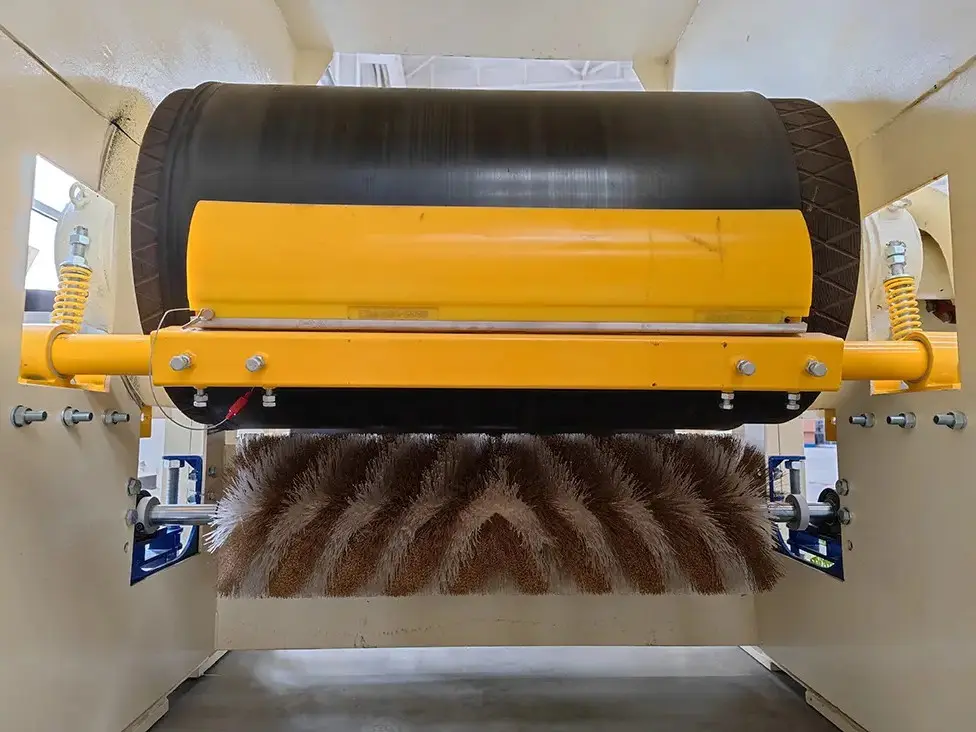
In the bulk material handling systems of heavy industries such as mining, metallurgy, power generation, building materials and ports, belt conveyors perform the core continuous transport task. However, many site technicians and maintenance teams frequently encounter a common and frustrating problem: the belt conveyor cleaner does not scrape cleanly, so a large amount of material falls along the return belt, causing a severe carryback phenomenon. This not only contaminates the production site and accelerates equipment wear, but also substantially increases cleaning costs and unplanned downtime. This article examines, objectively and professionally, why belt cleaners must be installed, and systematically analyses the six core causes of cleaner failure together with the corresponding countermeasures.
Chapter 1: Why install a belt cleaner? The core function of the cleaning device
A belt cleaner is a dedicated device used to remove adherent material and large lumps from the surface of the conveyor belt. Its core purpose is to reduce excessive belt wear, lower system energy consumption and ensure stable equipment operation. This is reflected in the following four aspects:
- Maintaining belt cleanliness and drive friction: ensure sufficient friction between the belt and the drive pulley to prevent belt slip and mistracking. If cleaning is incomplete, residual material enters directly between the pulley and the belt, causing local friction, surface wear and reduced overall transport efficiency.
- Reducing component wear and extending service life: effectively reduce the mechanical wear caused by sticky material and coarse particles on the conveyor belt, impact idlers and carrying idlers, significantly extending the service life of core components.
- Ensuring smooth operation: keep the belt running smoothly and prevent severe vertical and lateral jumping caused by local material build-up and scarring, thereby reducing the risk of longitudinal tearing.
- Protecting the entire line: as sticky material is reduced, carrying idlers, frames, drive pulleys and bend pulleys are comprehensively protected, ensuring normal system operation and greatly reducing the equipment failure rate.
Chapter 2: Correct classification and scientific selection of belt cleaners
To ensure cleaning performance, the rational layout of cleaners must first be understood. Cleaners can be broadly divided into three parts: primary (head) cleaners, secondary (middle) cleaners and tail cleaners. Their installation positions differ, and their duties and functions have different emphases.
1. Primary (head) cleaner
The primary cleaner cleans the top surface of the return belt at the discharge pulley and is usually supplied with the conveyor, often equipped with gravity-take-up and spring-tensioning devices. Standard belts generally use rubber blades, while high-strength belts mostly use alloy or polyurethane materials.
2. Secondary (middle) cleaner
The secondary cleaner cleans the non-working surface of the belt so that material adhering to the lower belt surface is carried as little as possible to the lower idlers and bend pulleys. It is usually installed within 5 metres behind the mid-section unloading point of the belt, or at the 2/3 position of the conveyor body (measured from the head). Standard belts use rubber blades; high-strength belts mostly use rubber or polyurethane.
3. Tail empty-run cleaner
The tail empty-run cleaner is responsible for cleaning the non-working surface ahead of the tail of the conveyor, and is generally installed within 5 metres in front of the tail impact idler frame. Standard belts use rubber blades; high-strength belts use rubber or polyurethane.
Chapter 3: Analysis of the six main causes of cleaner failure and poor scraping
In actual production, the reasons why a cleaner does not clean properly are often multiple. The following are the six common factors that lead to cleaner failure:
01. Incorrect cleaner selection
Cleaner selection must be strictly based on site operating conditions (material moisture, stickiness, lump size, belt speed, etc.); installing a product that does not match the duty is absolutely unacceptable. Common belt conveyor cleaners are classified by structure as: scraper type, rotary type, water-spray type, brush type, etc.; by material as: polyurethane cleaners, chrome-titanium-aluminium alloy, alloy-rubber cleaners, etc.; by working principle as: mechanical and electric. If the duty is extremely sticky but an ordinary rubber scraper is selected, poor cleaning is highly likely.
02. Improper cleaner installation position
Deviation from the optimum working zone creates cleaning dead zones. For example, if the primary cleaner is not positioned close to the separation point below the discharge pulley, or if the secondary and tail cleaners are too far from or too close to the material drop point, the return material cannot be effectively intercepted.
03. Severe blade wear
After a period of operation, the blade head rubs repeatedly against the belt surface, which easily causes mechanical wear of varying degrees. Once worn, a gap forms between the blade and the belt; when the contact fit is insufficient, cleaning performance deteriorates and material leaks directly through the gap.
04. Chute blockage
When material plugs near the cleaner or in the discharge chute, the accumulated material squeezes the cleaner and causes slight deformation, which directly changes the installation angle and contact pressure between the cleaner and the belt, leading to a sharp deterioration in cleaning performance.
05. Severe belt ageing
During long-term operation the belt is subjected to longitudinal tension and naturally ages as operating hours accumulate, producing fine micro-cracks on its surface. When these micro-cracks are opened and enlarged as the belt passes over the bend pulley, fine powdery material becomes embedded in them. Such micro-particles embedded in the aged belt body are very difficult to remove completely with conventional scraper blades and cleaners alone.
06. Overlong conveyor and running vibration
The longer the conveyor belt, the less stable the material discharge, and the more likely carryback and vertical belt bounce become. If damaged idlers are not replaced in time, or if idler surfaces are heavily built up with material, the longitudinal and lateral vibration of the belt is aggravated, so the cleaner cannot maintain stable and uniform contact with the belt.
Chapter 4: Countermeasures for material carryback and cleaning failure
In response to the various causes of cleaning failure described above, maintenance personnel should adopt the following targeted measures in daily management:
- Match the duty precisely: select blade material (alloy, polyurethane or composite) according to material characteristics (dry/wet, abrasiveness, stickiness).
- Regularly inspect and adjust the installation angle: frequently measure the contact angle between cleaner and belt; if the angle has changed due to blockage or external force, adjust and reset it in time.
- Replace worn blades promptly: establish a regular inspection system; when blades are severely worn or the gap exceeds the limit, adjust or replace them in time.
- Control discharge stability: promptly clean material build-up on idlers, replace damaged idlers, reduce belt vibration and ensure the cleaner always maintains good contact with the belt.
In actual production, the reasons why a belt conveyor cleaner does not clean properly may go beyond the six categories above. If you have encountered or know of other cases of cleaner failure, remember that in daily industrial maintenance, standardised installation and regular maintenance are the key to efficient and smooth operation of the conveying system.